Boone Adventures Mobile App
From concept to VC-ready prototype in a three-month accelerator. The founding team used the work to pitch venture capital groups and raise funding.
Overview
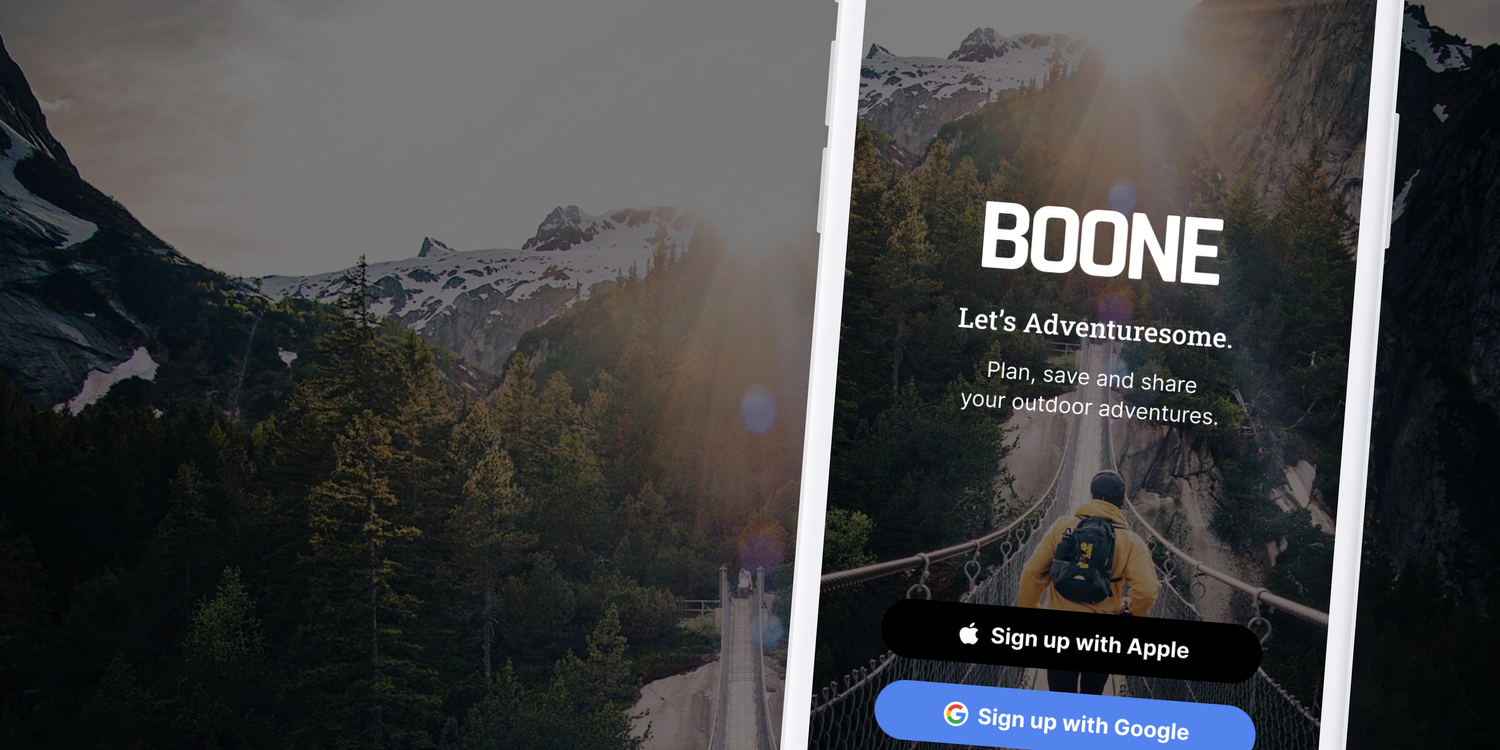
Boone Adventures was an early concept with three months of accelerator time and a founding team that needed something investors could hold. I took it to a high-fidelity clickable Figma prototype built around the group rather than the individual: trip planning, topographic and altitude-aware maps, discovery of sights and regions, shared memories. The team used the prototype and roadmap directly in their venture pitches.
Context & Constraints
Boone Adventures sat at the intersection of social planning and outdoor exploration. Friends needed a single place to coordinate calendars, meetups, maps and routes while also capturing the experience afterward. Core features included group planning tools, topographic and altitude-aware maps, discovery of sights and regions, plus easy sharing to social platforms.
The engagement ran inside a three-month accelerator-style program that followed a design-thinking structure. Time was limited and the concept was still early. The primary near-term goal was a polished prototype and clear roadmap that could support fundraising conversations.
My Role
As Product Design Lead at Strides Development I owned the design of Boone Adventures end to end: the information architecture, the interaction design, the high-fidelity Figma prototype and the materials the founders carried into their pitches. The call that shaped the product was making the group rather than the individual the unit everything is built around, from calendars and meetups through to how a trip gets remembered afterward.
I ran the discovery and prioritization workshops with the founding team inside a three-month accelerator, then put the prototype in front of users and ran short interviews that reshaped the navigation and the map interactions.
How I Approached It
I followed the accelerator program structure while keeping the work tightly focused on the highest-value user journeys. I began with brand and business discovery sessions to clarify the product's personality and the specific problems groups of friends faced when planning and documenting trips. Design workshops followed. We mapped the current pain points: scattered chats, lost details, hard-to-coordinate meetups. Then we brainstormed ideal solutions. Competitive audits and early user journeys helped surface the features that would matter most.
I designed the core flows in Figma, focusing on group calendaring and meetup coordination, map-based exploration with topographic and altitude context, saving and organizing shared memories and lightweight social sharing. We kept the experience oriented around the group rather than the individual, so that planning and remembering felt collaborative.
User testing and short interviews held up the three assumptions the concept rested on. Friends did want to build a trip together rather than be handed one, with topographic detail, nearby sights and somewhere to collect the photos afterward. The build held up too, because the topographic data already existed on open-source map services and the database could take edits from several people on the same trip.
The third assumption is the one that shaped the product. Organizers wanted admin rights and still needed everyone else contributing, and joiners would not engage until somebody had started a trip and planned it far enough to react to. That asymmetry is why the app has an organizer role and a joiner role rather than a single flat group.
Testing sent me back to the navigation, the map interactions and the memory-capture moments. The final phase produced a prioritized set of user stories, a development roadmap and a clickable prototype built around the whole idea in one line: adventure with friends. Plan, explore, reflect.
Key Decisions & Trade-offs
One of the clearest early decisions was to treat the group as the primary unit rather than building a traditional single-user travel app. That choice shaped everything from how calendars and meetups worked to how memories were saved and shared.
I also prioritized a strong map experience with topographic and altitude information over a long list of secondary social features. The maps needed to feel useful for real exploration, not just decorative. On the planning side I kept the first version focused on the essential coordination tools so the prototype stayed clear and fundable rather than feature-heavy.
Results
I delivered a high-fidelity, interactive Figma prototype along with the supporting discovery documents, prioritized stories and roadmap. The founding team used these assets directly in their pitches to venture capital groups. The work helped them present a concrete, visual product vision and contributed to a successful fundraising process.
Michael is an excellent addition to any team! He is not only an amazing product designer, he also incorporates user perspective through interviews, research and pure knowledge. He adds value by contributing with a mindset of a product owner and puts effort to make sure the product will succeed in all phases from planning to go-live. We have worked together in six different projects that started from the ideation phase and include mobile, widgets and web. In all projects Michael has been fundamental to the team!
Reflection
Working inside a fixed-length accelerator program reinforced how valuable it is to keep every workshop and design decision tied to a clear near-term outcome. In this case that outcome was a prototype and narrative strong enough for investor conversations. If I ran a similar engagement again I would bring one or two target users into the later prioritization sessions, so the final feature set could be pressure-tested against real group planning behavior even earlier.