WorkplaceAI Meeting Coach
The first AI meeting coach to market. It shipped before Zoom's comparable features, built on an opportunity tree that aligned executives on the biggest bets.
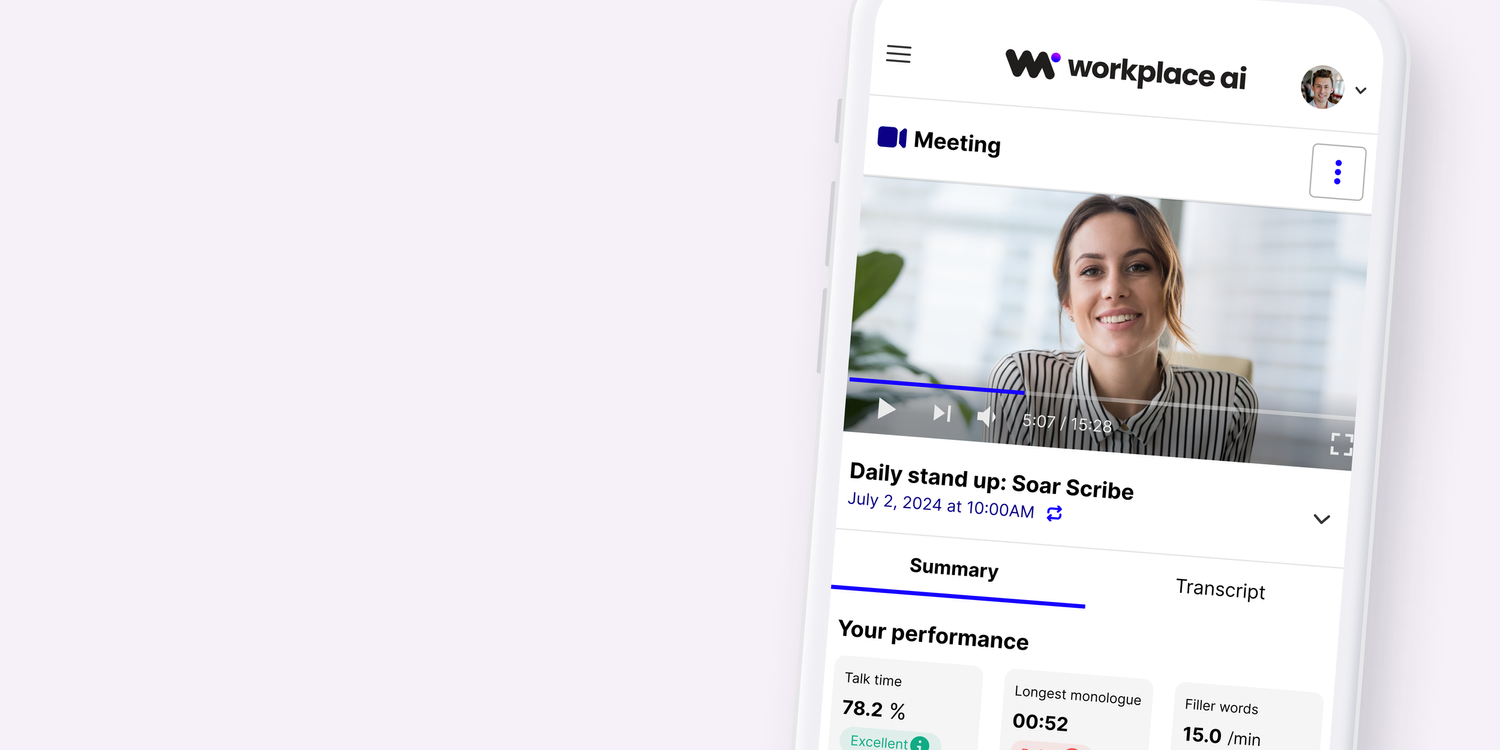
Overview
We shipped the first AI meeting coach to market, before Zoom offered anything comparable. It works as a virtual coworker rather than a recorder: it captures what got decided, coaches in real time and lives inside Slack and Google Drive where the work already happens. Getting there meant slowing down first. I ran the assumptions-matrix workshops and built the opportunity tree that tied every proposed solution to a business objective, which is what turned a room of strong opinions into a sequence everyone could agree on.
Context & Constraints
The product sat between meeting intelligence and workplace assistance. Teams were drowning in recordings and lost follow-ups. Leaders wanted clarity without adding another tool or another reason to feel watched.
The risk was as large as the opportunity. I was defining a category with no established patterns to copy. Every stakeholder arrived with a strong opinion about what "AI coaching" should mean, and the thing had to feel native on desktop, on mobile and inside tools people already had open.
My Role
I owned the design of WorkplaceAI from first principles through usability testing and launch: the five connected capabilities it shipped with, which are transcription, summary, decision tracking, action items and the coaching layer, plus the responsive design system behind them. The call that shaped the product was treating the AI as a collaborative coworker rather than a passive note-taker, so real-time coaching outranked transcription.
Before any of that I ran the assumptions matrix and the blue-ocean scoring workshops with product and executive stakeholders, then built the opportunity tree that tied every candidate solution to the business objective it would move. That artifact is what turned a room of strong opinions into a sequence everyone could agree on.
How I Approached It
I started with an assumptions matrix, built in blue-ocean workshops that scored every idea on feasibility, viability, strategic fit and desirability. A matrix does something a debate cannot: it makes the riskiest bet visible to everyone in the room at the same moment.
Then I designed lightweight experiments against the highest-uncertainty assumptions, before anyone committed engineering time. Cheap tests, early. That is the whole trick.
The experiments told me which assumptions survived, so I built an opportunity tree with the team that organized every candidate solution under the business objective it would move. That was the artifact that got executives and product leaders agreeing on sequence rather than on features.
With priorities settled I moved into ideation. I built a new design system for responsive desktop and mobile from first principles, then tested its patterns against the personas we were actually serving: founders and executives, sales leaders, remote and hybrid teams, HR and operations. New branding rolled out alongside the product so nothing felt bolted on.
Key Decisions & Trade-offs
Slowing down long enough to run the matrix and the tree, instead of going straight to feature design. It cost time up front and it stopped the team building the wrong things first, which is a trade I would make again every time.
Treating the AI as a collaborative coworker rather than a passive note-taker. That meant real-time coaching and context-specific answers took priority over transcription, which is the easier thing to build and the less useful thing to have.
Integrating deeply into tools people already used rather than becoming another destination app. Deep integration and real-time coaching both raised the technical complexity, and both matched how people actually work.
Results
WorkplaceAI shipped as a first-to-market solution that turned meeting recordings into structured decisions, action items and performance coaching. The opportunity tree and prioritization workshops gave stakeholders a shared view of which solutions would move the most, which produced a focused launch rather than a scatter of features. It shipped ahead of equivalent features later adopted industry-wide by platforms like Zoom.
Michael is an excellent addition to any team! He is not only an amazing product designer, he also incorporates user perspective through interviews, research and pure knowledge. He adds value by contributing with a mindset of a product owner and puts effort to make sure the product will succeed in all phases from planning to go-live. We have worked together in six different projects that started from the ideation phase and include mobile, widgets and web. In all projects Michael has been fundamental to the team!
Reflection
A shared visual model does something no meeting can when executives and product teams start from different ideas of what AI should do. The opportunity tree gave them one picture to argue over instead of five.
The cheap early experiments mattered more than I expected. They turned abstract enthusiasm into evidence, which is the only thing that reliably changes a senior stakeholder's mind.
If I ran a similar zero-to-one effort now I would put real end users in the opportunity tree sessions, so the business objectives got stress-tested against daily pain earlier than they were.